Health and Safety Policy for Commercial Waste Removal Southgate
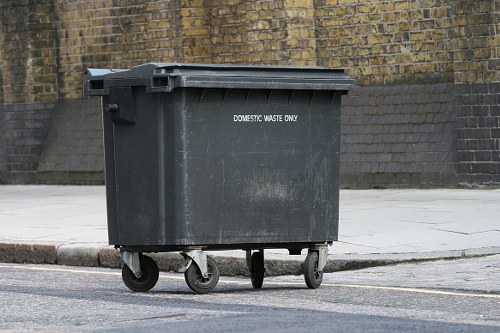 Policy statement: Commercial Waste Removal Southgate maintains a clear, documented health and safety policy that prioritises the wellbeing of employees, contractors, clients and the public during all stages of commercial rubbish collection and waste removal operations. This policy applies to every aspect of our rubbish collection services, from depot operations and vehicle routes to on-site handling and off-site disposal. We commit to continuous improvement in safety performance, compliance with statutory duties, and the promotion of a safe working culture across the service area.
Scope and objectives: The objective of this document is to set out responsibilities, safe systems of work, training requirements and monitoring arrangements for commercial waste removal and related services. Our aim is to eliminate preventable incidents, reduce occupational risks, and ensure that waste removal teams operate with appropriate controls when handling general refuse, recyclable materials and low-risk commercial waste. The policy also addresses vehicle safety, site access, manual handling and the correct use of lifting and containment equipment used in commercial refuse removal.
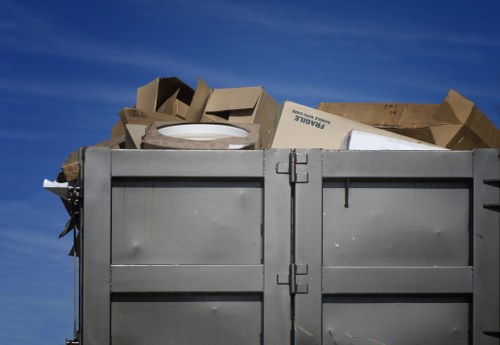 Key responsibilities: Senior management retains ultimate responsibility for health and safety policy implementation and resource allocation for the waste removal business. Supervisors and fleet managers are responsible for risk assessments, route planning and ensuring crews follow safe systems of work. Employees and operatives are expected to:
- Follow safe operating procedures for commercial rubbish removal;
- Use appropriate PPE and safety equipment;
- Report hazards, near misses and incidents immediately.
Risk assessment and control measures
All commercial waste removal tasks will be subject to dynamic and formal risk assessments. These identify hazards such as manual handling injuries, vehicle movements, slips and trips, hazardous substances and site-specific risks. Control measures include safe loading practices, segregation of waste streams, use of mechanical aids, and strict protocols for handling any potentially hazardous or unknown materials encountered during rubbish removal activities. Remedial actions are recorded and tracked to closure.Training, competence and supervision
Personnel engaged in commercial waste removal services must receive induction training, role-specific instruction and periodic refresher sessions. Training covers safe vehicle operation, secure loading, manual handling techniques, spill response, and emergency procedures. Supervisors carry out competency checks and ensure that all operatives are familiar with the company’s waste removal services processes and safety expectations. Records of training and assessments are maintained and reviewed as part of our continuous improvement programme. Vehicles, equipment and maintenance: Fleet safety is central to safe rubbish collection operations. Vehicles are inspected daily, subject to scheduled maintenance, and fitted with appropriate safety equipment including reversing alarms, cameras, secure load restraints and first aid kits. Mobile plant and containment units used for commercial rubbish removal are maintained in line with manufacturer and industry standards. Defects are reported immediately and equipment withdrawn from service until repaired.
Personal protective equipment and hygiene: Appropriate PPE — high-visibility clothing, gloves, safety footwear and eye protection where required — must be worn on duty. Hand hygiene facilities and procedures are provided to reduce exposure to contaminants. Staff are trained on the correct selection, inspection and disposal of PPE where items become contaminated during commercial waste handling operations.
 Hazardous and special wastes: Although this policy focuses on routine commercial refuse and waste removal, operatives must be able to recognise materials outside their remit (for example, controlled hazardous waste, asbestos-containing materials or illicit substances). When such items are identified, crews will follow established isolation and reporting procedures and will not handle materials beyond their authorised competence. Specialist contractors or licensed disposal routes will be used for regulated waste streams.
Site procedures and public safety: Work areas must be secured to protect members of the public and client personnel. Signage, barriers and exclusion zones are used where necessary. Loading and unloading operations are planned to minimise disruption and to ensure safe access for pedestrians and other site users. Our teams coordinate with client site managers to confirm safe operating areas before commencing work on commercial premises.
Incident reporting, emergency response and first aid
All incidents, near misses and accidents are recorded, investigated and analysed to prevent recurrence. Emergency response plans cover vehicle incidents, injuries, fires and hazardous material exposures. First aid provision and trained responders are available on site or within the fleet, and clear escalation routes are defined for medical emergencies and serious incidents within commercial waste removal operations.
Monitoring, audit and continual improvement
We conduct regular safety audits, compliance checks and performance reviews to assess the effectiveness of controls. Key performance indicators include incident rates, training completion, defect reports and corrective action closure times. Findings inform updates to procedures, targeted training and resource allocation to further reduce risk across our rubbish removal and commercial waste services.Policy review: This health and safety policy is reviewed at least annually and whenever there are significant changes to operations, equipment or regulatory expectations. Management commits to providing necessary resources and leadership to ensure that health and safety remain integral to all commercial waste removal activities. All staff are expected to contribute to a positive safety culture through compliance, communication and collaborative problem solving.
